
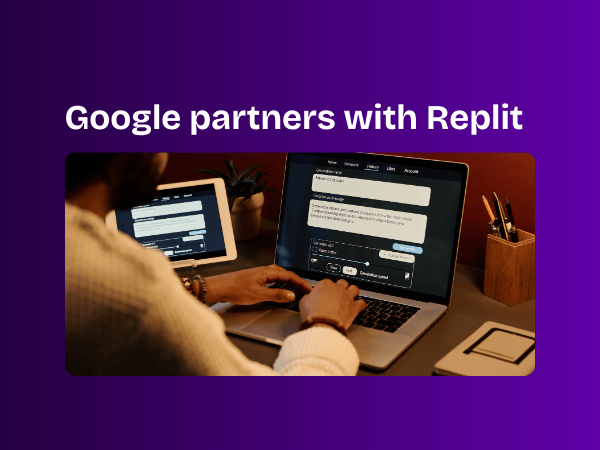
Google partners with Replit in a bid to accelerate the emerging trend of vibe coding, a workflow that lets developers generate software from high-level intent rather than line-by-line programming. The collaboration, announced on December 9, 2025, aims to integrate Google’s AI models with Replit’s cloud-based development environment. Together, the companies plan to simplify how developers ideate, prototype, and ship software.
The move matters because vibe coding is quickly becoming a core workflow across the industry. Major tech companies are racing to optimize systems that let developers describe what they want and let AI produce functional code. By combining Google’s AI infrastructure with Replit’s widely used coding platform, the partnership positions both companies to influence the next generation of software development.
How the Google–Replit partnership works
Google partners with Replit to embed its latest generative AI models directly into Replit’s development tools. This includes model access through Replit’s workspace interface, expanded API capabilities, and future integration with Google Cloud services.
Replit, known for its real-time collaborative coding and AI-assisted workflows, gains a significant performance boost. Developers will be able to use Google-enhanced AI agents to plan, write, test, and deploy applications from a single environment.
Replit has long advocated for intent-driven software creation, and this deal elevates that mission. By fusing Replit’s coding UX with Google’s model strengths in reasoning and code generation, both companies expect major workflow efficiency gains across web, mobile, and backend development.
Why vibe coding is becoming a strategic battleground
Vibe coding describes a shift from traditional programming to higher-level AI-assisted development. Instead of crafting code manually, developers articulate goals, constraints, and design intentions.
Google partners with Replit to deepen support for this workflow at a moment when competitors are also moving aggressively. OpenAI has been pushing agent-based coding systems, while Microsoft continues to unify GitHub Copilot, Azure, and Windows development tools.
Google’s investment signals that it wants a stronger foothold in the coding-assistant ecosystem. It also gives Replit additional resources and credibility as the platform scales.
The partnership reflects a broader belief that AI-native development environments will become standard. Early adopters already report faster prototyping and reduced cognitive load compared to traditional IDE-driven workflows.
Impact on developers and the broader coding ecosystem
Developers stand to gain streamlined pipelines for everything from quick prototypes to production-ready software. The integration promises faster debugging, automated documentation, cloud deployment hooks, and multi-language code generation.
For startups and indie developers, Google partners with Replit to provide enterprise-grade AI tooling without the overhead of managing infrastructure. Students and hobbyists may also benefit from more accessible learning experiences.
However, the shift raises questions around code reliability, security, and oversight. As vibe coding becomes more dominant, best practices for validation and human review will remain critical. Google and Replit say the combined platform will offer guardrails to reduce hallucinations and improve output integrity as models evolve.
Strategic implications for Google and Replit
For Google, partnering with Replit expands its reach beyond core cloud customers and into grassroots developer communities. It positions Google as a key player in the coming era of AI-generated software and provides a counterweight to Microsoft’s Copilot ecosystem.
For Replit, the partnership strengthens its platform at a pivotal time. Access to Google’s AI models and infrastructure could accelerate Replit’s roadmap, improve performance, and help scale to millions more users globally.
Industry analysts note that as companies battle for dominance in AI-assisted programming, partnerships like this could define who controls developer mindshare for the next decade.
What comes next
Both companies say deeper integrations will roll out through 2026, along with expanded model support and new workflow automation features. Developers can expect tighter alignment between Replit’s collaborative editor and Google’s AI agents, especially around planning, testing, and deployment tools.
Whether the partnership reshapes the coding landscape will depend on execution, but experts say it signals a clear direction: AI-native coding is moving from novelty to mainstream practice.

